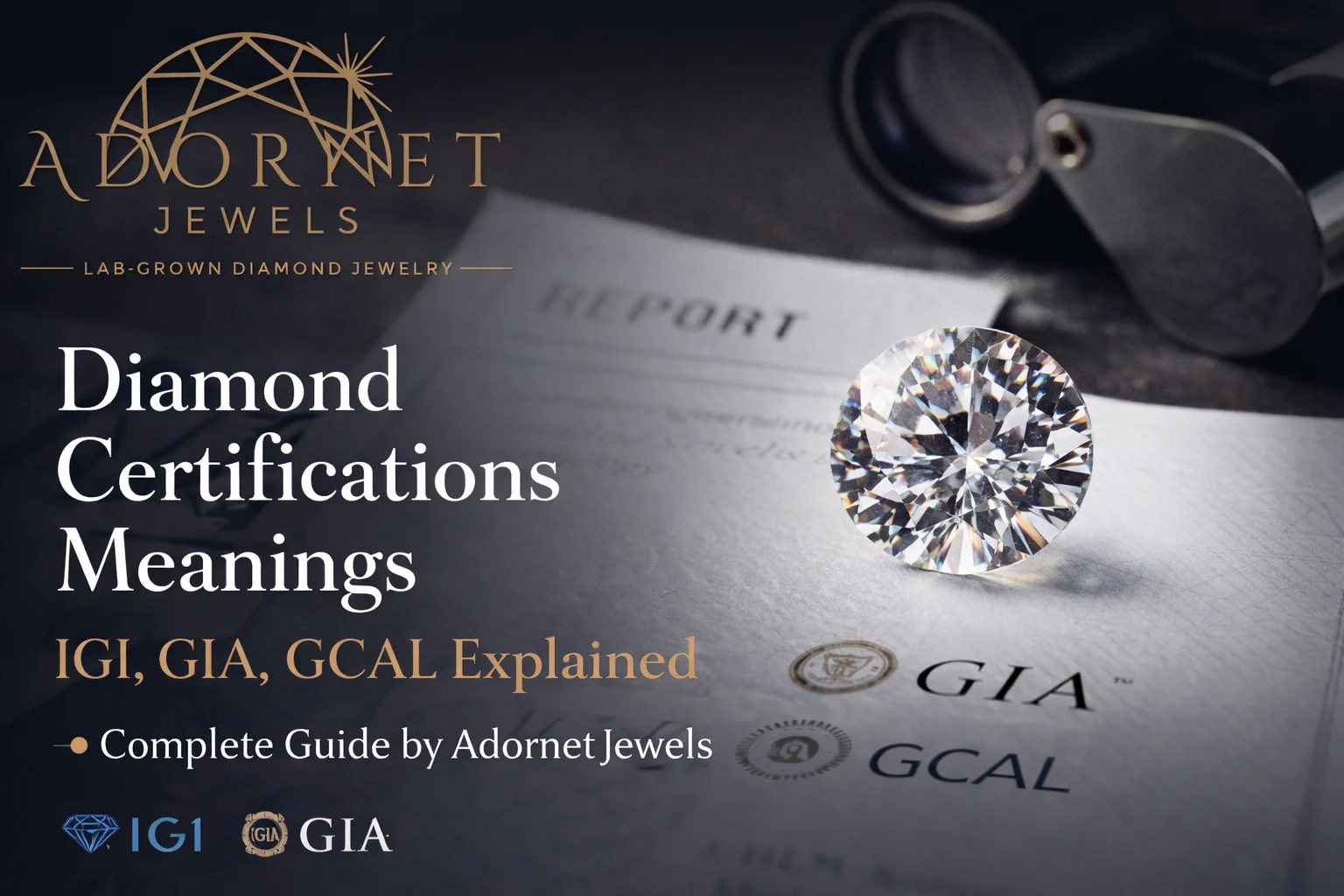
Diamond Certifications Meanings: IGI, GIA, GCAL Explained - Adornet Jewels
Buying a diamond is an exciting moment. Whether you are a retail buyer purchasing a timeless engagement ring or a wholesale jewellery business sourcing premium lab grown diamonds, one question always comes up:
How do you know the diamond is truly high quality?
The answer lies in diamond certifications.
A diamond certification acts like a report card for your diamond. It objectively evaluates the stone based on internationally accepted standards. Without certification, purchasing a diamond can feel like buying a luxury watch without knowing if the movement inside is genuine.
In today’s global jewellery market, certifications such as GIA, IGI, and GCAL ensure buyers get exactly what they pay for. These certifications analyze the diamond 4 C (cut, color, clarity, and carat weight) and provide detailed grading information.
For retail customers, this means peace of mind.
For wholesale buyers, it guarantees consistency and trust when purchasing diamonds in bulk.
Leading jewellery manufacturers like Adornet Jewels prioritize certified diamonds to maintain premium quality standards in lab grown diamond jewellery collections.
As a leading lab grown diamond jewellery manufacturer, Adornet Jewels crafts world-class jewellery for:
- Jewellery retailers
- Global wholesalers
- Private label brands
- Luxury jewellery collections
This complete guide will help you understand:
- What diamond certifications mean
- Types of diamond certifications
- Differences between GIA, IGI, and GCAL
- How the diamond 4 C grading system works
- Which diamond quality is best for buyers
- Why certifications matter for lab grown diamonds
Let’s explore the fascinating world of certified diamonds.
What Are Diamond Certifications?
A diamond certification is an official document issued by a professional gemological laboratory that analyzes and grades a diamond.
The certificate contains detailed information about the diamond’s characteristics, including:
- Carat weight
- Color grade
- Clarity grade
- Cut quality
- Measurements and proportions
These reports are created by independent laboratories, meaning they provide an unbiased evaluation of the diamond.
In simple terms, a diamond certificate guarantees authenticity and quality.
Imagine purchasing a luxury car without knowing the engine size, mileage, or performance specs. It would feel risky, right?
Similarly, buying a diamond without certification leaves buyers uncertain about its real value.
This is why certified diamonds are now the global standard for both retail and wholesale jewellery markets.
Why Diamond Certifications Matter
Diamond certifications play a crucial role in the jewellery industry.
Here’s why they are essential:
- Authenticity Verification
Certifications confirm the diamond is real and not a simulant.
- Accurate Quality Assessment
Independent labs use scientific tools to evaluate the diamond 4 C.
- Fair Market Pricing
Diamond prices vary dramatically based on quality. Certification ensures transparent pricing.
- Buyer Confidence
Retail customers feel secure knowing their diamond has been professionally graded.
- Trust in Wholesale Transactions
Jewellery retailers and wholesalers rely on certification to maintain consistent inventory quality.
In today’s jewellery market, certified diamonds are not just preferred — they are expected.
Understanding the Diamond 4 C
The diamond 4 C grading system is the universal standard used to evaluate diamond quality.
These four characteristics determine the beauty and value of a diamond.
- Cut
Cut refers to how well the diamond is shaped and polished.
A well-cut diamond reflects light beautifully, producing maximum brilliance and sparkle.
Cut grades include:
- Excellent
- Very Good
- Good
- Fair
- Poor
Among all the 4Cs, cut has the biggest impact on a diamond’s brilliance.
2. Color
Diamonds are graded based on how colorless they are.
The grading scale ranges from D to Z.
- D–F: Colorless (highest quality)
- G–J: Near colorless
- K–M: Slight color
- N–Z: Visible yellow tint
Colorless diamonds are rarer and more valuable.
3. Clarity
Clarity measures internal flaws called inclusions and external marks called blemishes.
Clarity grades include:
- FL – Flawless
- IF – Internally Flawless
- VVS – Very Very Slight Inclusions
- VS – Very Slight Inclusions
- SI – Slight Inclusions
- I – Included
Higher clarity diamonds have fewer imperfections.
4. Carat Weight
Carat measures the weight and size of a diamond.
1 carat equals 200 milligrams.
However, a larger diamond does not always mean better quality. A smaller diamond with excellent cut and clarity can appear more brilliant.
Types of Diamond Certifications
There are several diamond grading laboratories worldwide. However, the most recognized types of diamond certifications include:
GIA – Gemological Institute of America
The global benchmark for diamond grading.
IGI – International Gemological Institute
Popular certification for lab grown diamonds.
GCAL – Gem Certification & Assurance Lab
Known for advanced grading accuracy and guarantees.
Each certification laboratory uses specialized equipment to analyze diamonds under strict grading standards.
GIA Diamond Certification Explained
The Gemological Institute of America (GIA) is considered the most prestigious diamond grading authority.
Diamonds that are diamond certified GIA are highly respected in the global jewellery industry.
Why GIA is trusted
- Extremely strict grading standards
- Highly consistent reports
- International reputation
A GIA certificate includes detailed analysis, such as:
- Diamond 4 C grading
- Proportions diagram
- Fluorescence information
- Laser inscription number
Many luxury jewellery brands prefer GIA-certified diamonds because they provide unmatched credibility.
IGI Diamond Certification Explained
The International Gemological Institute (IGI) is one of the most widely used diamond grading laboratories.
It is particularly known for certifying lab grown diamonds.
Why IGI is popular
- Widely accepted globally
- Trusted for lab grown diamonds
- Efficient certification process
Today, a large portion of lab grown diamond jewellery collections carry IGI certification.
This certification allows buyers to verify the diamond’s origin and quality.
GCAL Diamond Certification Explained
The Gem Certification & Assurance Lab (GCAL) offers highly detailed diamond grading reports.
One unique feature of GCAL is its grading accuracy guarantee.
Key features of GCAL certification
- Optical symmetry analysis
- Light performance grading
- Digital diamond fingerprinting
- Money-back guarantee on grading accuracy
GCAL is gaining popularity among premium jewellery collectors and luxury brands.
IGI vs GIA vs GCAL – Key Differences
Feature | GIA | IGI | GCAL |
Global Reputation | Excellent | Very Good | Very Good |
Best For | Natural diamonds | Lab grown diamonds | Precision grading |
Grading Strictness | Very strict | Moderate | Strict |
Popularity | Luxury market | Lab grown market | Premium collectors |
Each certification has strengths depending on the type of diamond and buyer needs.
Which Diamond Quality Is Best?
A common question among buyers is:
Which diamond quality is best?
The answer depends on a combination of the diamond 4 C and certification.
Ideal diamond quality combination
- Cut: Excellent
- Color: D–F
- Clarity: VS1 or better
- Certification: GIA or IGI
For lab grown diamonds, IGI certification is widely accepted in the jewellery industry.
The most important factor is cut quality, as it determines the diamond’s brilliance.
Natural vs Lab Grown Diamonds Certification
Both natural and lab grown diamonds require certification.
However, the market trends differ.
Natural Diamonds
Often certified by GIA.
Lab Grown Diamonds
Commonly certified by IGI.
Lab grown diamonds have become extremely popular because they offer:
- Ethical sourcing
- Sustainable production
- Affordable luxury
- Identical chemical structure to natural diamonds
Leading jewellery manufacturers like Adornet Jewels specialize in premium lab grown diamond jewellery collections designed for modern markets.
Why Certification Is Crucial for Retail Buyers
Retail customers benefit greatly from certified diamonds.
Benefits for buyers
- Verified diamond quality
- Authentic certification reports
- Fair pricing
- Higher resale value
Certification ensures customers receive exactly what they expect when purchasing a diamond.
Why Certification Matters for Wholesale Buyers
For wholesale diamond buyers, certification is essential.
Bulk diamond sourcing requires:
- Consistent grading standards
- Transparent pricing
- Reliable supply chains
Certified diamonds make it easier for jewellery retailers to maintain quality control across large inventories.
How to Read a Diamond Certification Report
A diamond certification contains multiple sections.
Key information in the report
Diamond Shape
Round, oval, princess, cushion, etc.
Measurements
Precise dimensions of the diamond.
4C Grading
Detailed evaluation of cut, color, clarity, and carat.
Fluorescence
Indicates how the diamond reacts to UV light.
Laser Inscription
A unique number engraved on the diamond.
This number matches the certificate and confirms authenticity.
How Certified Diamonds Impact Pricing
Diamond pricing is directly influenced by certification.
Two diamonds that appear identical may have very different prices depending on their grading reports.
Factors affecting price include:
- Higher cut grades
- Colorless diamonds
- Higher clarity
- Larger carat weight
- Trusted certification labs
Certified diamonds ensure buyers are paying accurate market value.
Why Choose Adornet Jewels for Certified Lab Grown Diamond Jewellery
When sourcing premium diamond jewellery, choosing the right manufacturer is critical.
Adornet Jewels is a leading lab grown diamond jewellery manufacturer delivering world-class craftsmanship from the heart of Bangkok.
With over two decades of expertise, Adornet Jewels has become a trusted partner for retailers, wholesalers, and private label jewellery brands worldwide.
What makes Adornet Jewels unique
Premium Lab Grown Diamond Jewellery
Every piece is crafted using high-quality certified diamonds that meet global standards.
Elegant Gold Collections
Adornet Jewels designs luxurious jewellery collections crafted in premium gold settings.
Custom Jewellery Manufacturing
Retailers and brands can develop exclusive jewellery collections.
Trusted by Global Wholesalers
Adornet Jewels supplies jewellery to international markets, helping brands scale their collections.
Private Label Jewellery Manufacturing
Businesses can launch their own jewellery brand using Adornet Jewels’ expert design and manufacturing services.
Conclusion
Diamond certifications are the backbone of trust in the jewellery industry.
They provide transparency, authenticity, and accurate grading, ensuring buyers receive genuine value when purchasing diamonds.
Understanding the diamond 4 C, types of diamond certifications, and differences between GIA, IGI, and GCAL helps buyers make confident decisions.
As the demand for lab grown diamonds continues to grow, certified diamonds are becoming the industry standard.
For businesses looking to source premium lab grown diamond jewellery, Adornet Jewels offers world-class craftsmanship, certified diamonds, and customized jewellery manufacturing for retailers, wholesalers, and private labels globally.
FAQ'S
What are diamond certifications?
Diamond certifications are grading reports issued by professional gemological laboratories that verify a diamond’s authenticity and evaluate its quality using the diamond 4 C grading system.
What does diamond certified GIA mean?
A diamond certified GIA means the diamond has been graded by the Gemological Institute of America, one of the most trusted diamond certification authorities worldwide.
Which diamond certification is best?
The most trusted diamond certifications include GIA, IGI, and GCAL. Each provides reliable grading standards depending on the diamond type.
Are lab grown diamonds certified?
Yes, lab grown diamonds receive certifications from laboratories such as IGI and GIA, confirming their authenticity and quality.
Why should wholesale buyers prefer certified diamonds?
Certified diamonds ensure consistent quality, transparent pricing, and greater trust with customers, making them ideal for wholesale jewellery businesses.